
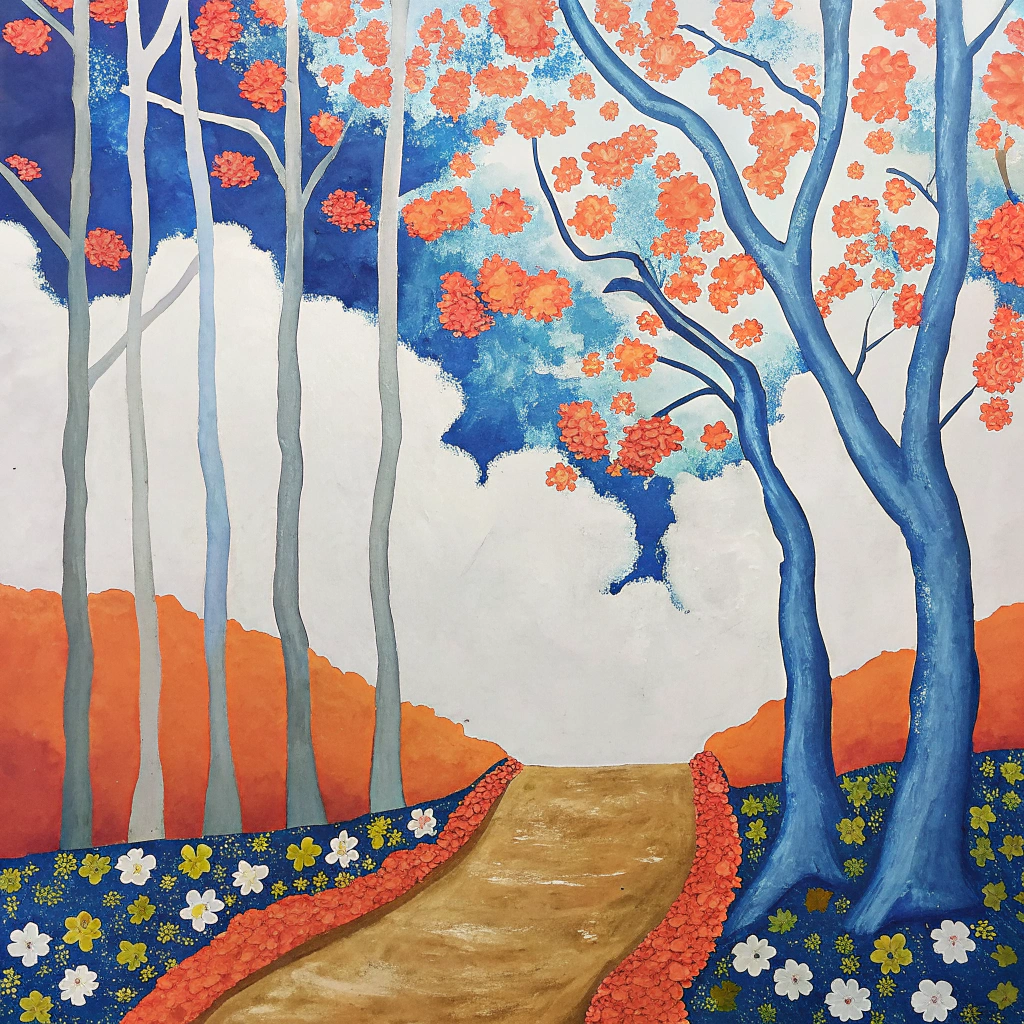
In San Francisco, you can hear the sound of spring arriving.
It has already been four years since I retired in Korea,
and more than two years since I began living here with my daughter.
What once felt unfamiliar about life in the United States
has slowly settled into something resembling routine.
Today, drawn by the warmth of the sun, my wife and I stepped out for a walk through the neighborhood.
The areas surrounding San Francisco are filled with pleasant walking paths.
Here, they are called “trails.”
Even narrow paths that cross over gentle ridges are carefully marked with wooden signs,
bearing names that feel both familiar and strangely foreign.
Walking paths in Korea are well maintained these days too,
but the trails here preserve more of nature in its original state.
The scent of trees, the smell of earth,
and grasses of unknown names swaying in the breeze
have a calming effect on the mind.
Perhaps because it was a weekday afternoon,
only a few elderly people were out—some cycling, others walking slowly.
I decided to run about seven or eight kilometers for the first time in a while.
Not long after leaving my wife behind and picking up my pace,
I began to hear a faint sound.
It came from the low grass along the side of the trail.
Tick. Tick.
At first, I wondered if it was an insect.
But as I kept running, the sound repeated with a steady rhythm.
It didn’t feel like something made by a living creature—
it sounded as if it were coming from somewhere beneath the ground.
Then a thought crossed my mind:
Could this be the sound of frozen earth beginning to thaw?
And suddenly, I realized—
Perhaps this was the sound of spring arriving in San Francisco.
Nature here feels different from Seoul.
The air is clear and the sky is wide,
yet somehow the starlight feels faint.
Even on a full-moon night,
the moonlight never seems to fully settle into the world.
In contrast, the sunlight is intense—
so bright it feels like a searchlight shining directly into your eyes.
The same full moon, seen in Dalian, China,
once felt close enough to touch, just beyond a hill.
The moon in Seoul felt warmer than that.
And the moon I see here now appears strangely muted,
different from the one stored in my memory.
Time spent in unfamiliar places has a way of making
even the most familiar things feel distant.
As I walked, my thoughts naturally drifted back
to the moment I left Korea.
Over the past two years, I traveled back and forth between Korea and the United States several times.
I thought I had moved a step away from feelings like longing or desperation.
And yet, from time to time, an unexplainable heaviness still settles in.
When riding the subway past old railway lines near places like Noryangjin,
or traveling from Bundang toward Incheon,
I would stare out the window and feel a strange ache.
The word home would surface,
and memories of past years would quietly follow.
In truth, I don’t have many places I can confidently call a hometown,
nor many faces I could easily call friends.
Seoul changed constantly as I was growing up.
The uphill road by the railroad tracks in Donggyo-dong,
where I spent my childhood,
has now become a landmark near Hongdae.
That was once my home—
but it no longer belongs to me.
Seoul was always that kind of city:
constantly being built, then torn down again.
Perhaps it is only now beginning to age into its own history.
Leaving Korea required me to process emotions I couldn’t quite name.
Was it regret over leaving a familiar place?
Or fear of growing older?
And so I left,
and now I spend quiet days in a small city about twenty minutes from San Francisco.
While others travel through Europe after retirement,
I chose to settle here.
Perhaps this life—moving back and forth between Korea and the United States—
has been my greatest change, and my greatest challenge.
Leaving always stirs the heart.
But thinking about it now,
does where we live truly matter that much?
I have always been a traveler on this planet.
Even when I lived in Seoul, I was a traveler.
And here, I am still on the journey.
Perhaps there was never such a thing as a permanent home to begin with.
It seems foolish for someone who chooses their destination
to complain about its inconveniences—
just as a traveler to Antarctica would not protest the cold.
All I can do is accept and enjoy this moment as it is.
Instead of walking the streets of Rome,
I am walking the trails of Orinda, a small town in California.
And by the end of this year, or the next,
I will likely be walking the streets of Seoul again.
That day, too, will be filled with the excitement of a new journey.
Then, suddenly, I realized what the sound of spring truly was.
Tick. Tick.
It was the plastic tips at the ends of the drawstrings on my hood,
tapping against each other as I ran.
They happened to be the same length,
swaying with my movement and occasionally meeting to make that sound.
Spring, it turns out,
arrives through the smallest of things.
Leave a Reply